Showing posts with label computer networks and communication. Show all posts

Sunday, 17 February 2013

UGC NET previous question paper

June 2010

27. What does the URL need to access documents?
I. Path name II. Host name
III. DNS  IV. Retrieval method
V. Server port number
(A) I, II, III (B) I, III, V
(C) I, II, IV (D) III, IV, V

28. End-to-End connectivity is provided from Last-to-Last in
(A) Network layer (B) Session layer
(C) Transport layer (D) Data link layer

29. What services does the internet layer provide ?
1. Quality of service 2. Routing
3. Addressing  4. Connection oriented delivery
5. Framing bits
(A) 1, 2, 3 (B) 2, 3, 4
(C) 1, 3, 4, 5 (D) 2, 3, 4, 5

UGC NET Previous Year Questions


June 2008 and December 2007

26. The ATM cells ------ byte long
(a) 48 (b) 53 (c) 64 (d) 69

27. For slotted ALOHA maximum channel utilization is
(a) 100% (b) 50% (c) 36% (d)18%

28. For channel of 3 kHz bandwidth ands signal to noise ratio of  30db the maximum data rate is
(a) 3000bps (b) 6000bps (c) 15000bps (d) 30000bps

29. An example of public key encryption algorithm is
(a)    Ceaser cipher algorithm (b) DES algorithm (c) AES algorithm (d) knapsak algorithm

30. With reference to hierarchical routing the optimum number of levels for an m router subnet is
(a) m^2  (b) m (c) ln m (d) square root of m

UGC NET Sample Questions Networks and communications

June 2012
11. X.25 is ________ Network.
(A) Connection Oriented Network
(B) Connection less Network
(C) Either Connection Oriented or Connection Less
(D) Neither Connection Oriented nor Connection Less
Answer: A

29. Which of the following IP address class is a multicast address?
(A) Class A (B) Class B
(C) Class C (D) Class D
Answer: D

41. Which layer of OSI reference model uses the ICMP (Internet Control Message Protocol)?
(A) Transport layer
(B) Data link layer
(C) Network layer
(D) Application layer
Answer: C

54. What is the size (in terms of bits) of Header length field in IPV4 header?
(A) 2 (B) 4
(C) 8 (D) 16
Answer: B

Saturday, 16 February 2013

RSA Algorithm


RSA is a public key algorithm (Asymmetric key cryptography), named after its inventors Rivest, Shamir, and Adleman. It uses two keys e and d as the public and private keys. The key selection steps are as follow,
  • Receiver (Bob) choose two large prime numbers p and q.
  • Bob find out n as: n=p*q Note that the value of p must be less than n. otherwise we need to divide the plaintext into blocks in-order p less n.
  • Bob calculate another number z as: z=(p-1)*(q-1)
  • Bob choose a random integer e, and calculate d as: d*e= 1 mod z
  • Bob keeps z and d as secret, announces e and n to public.

Any sender, who need to send data to Bob generate ciphertext as follow:
                        C=Pe mod n
Where p is the data to send and n and e are keys announced by Bob to public.

Modern Ciphers

Here we discuss some modern ciphers, modern ciphers are bit oriented. Some simple modern ciphers are XOR, Rotation, Substitution cipher (s-box), Permutation cipher (p-box).

XOR Cipher
XOR ciphers use logical XOR operation to produce ciphertext. Two inputs are needed for XOR cipher algorithm, one input from plaintext and other input is the key to encrypt. The inputs are just XORed to produce ciphertext.

Rotation Cipher
Rotation ciphers rotate the bits in the input plaintext to produce the ciphertext. Rotation ciphers can be either keyed or keyless. The number of rotation must be in between 1 to N-1 for an N bit input. After Nth rotation, we get the original string.

Substitution cipher: S-box
It is a parallel version of traditional substitution cipher. The input to an S-box is a group of bits with length N and the output is another group of bits with length M (M and N need not to same).

Cryptography


Cryptography comes from Greek words for “secret writing”. In cryptography, the plain text messages are transformed to ciphertext messages, in-order to provide security. The process of transforming plaintext to ciphertext is known as encryption and process of transforming ciphertext to plaintext is known as decryption. The process of braking ciphers, known as cryptanalysis, and the art of devising them known as cryptology. Cryptography algorithms are divided into two categories: symmetric key (or secret key) algorithms and asymmetric key (or public key) algorithms.

Cryptography
Cryptography 
Symmetric key cryptography
In symmetric key cryptography, sender uses the key and encryption algorithm to produce ciphertext. Receiver uses the same key and decryption algorithm to decrypt ciphertext. The key used here is secret, it is only known to sender and receiver (not known to public).  

Wednesday, 13 February 2013

ISDN

Integrated Service Digital Network
ISDN (Integrated Service Digital Network) is a design for digital telephone/communications network. ISDN provide a wide range of services including voice, video, data etc. ISDN is a circuit switched telephone network even though it provides access to packet switched networks. The system allows simultaneous transmission of data and voice using end-to-end connectivity. Generally, ISDN has three layers that are respectively works in first three layers of the OSI model.  In ISDN, voice and data are carried by B channels (bearer channels) support a bandwidth of 64 Kbit/sec. The D channel (data channel) of the ISDN is used for signaling, it support 16 Kbit/sec. Two basic ISDN interfaces are Basic Rate Interface (BRI) and Primary Rate Interface (PRI).

Basic Rate Interface
BRI consists two B-channels and a D-channel (2*64+1*16=144 Kbit/sec). BRI services are mostly focused on individual users.

Tuesday, 12 February 2013

Firewalls

Firewall is a device (either software or hardware) installed between internal network of and the Internet. Primary objective of the firewall is to control the incoming and outgoing packets and decide whether the packet is allowed or not. That means, the firewall forward some packets and filter (not forward) some others. Firewalls are categorized into packet filter firewalls and proxy filter firewalls.

Packet Filter Firewall

Packet filter firewalls use network and transport layer headers: source and destination addresses, source and destination port addresses, and protocol used (TCP or UDP) to determine whether the packet is forward or block. A packet filter firewall filters at network or transport layer. These types of firewalls use filter tables to make decisions. The following figure shows a filter table.
Packer filter firewall
  
Interface
Source IP
Source Port
Destination IP
Destination Port
1
15.153.126.32
*
*
*
1
*
*
150.127.125.10
*
1
*
*
*
50
2
*
80
*
*


The asterisk (*) means any.

Monday, 11 February 2013

FDMA TDMA and CDMA


Channelization
This is another method to share available bandwidth of a channel among multiple stations. Here we discuss three channelization protocols: FDMA, TDMA, and CDMA.

Frequency Division Multiple Access

In frequency division multiplexing the available bandwidth is divided into different frequency bands. And each station allocate a specific frequency band for send data. Guard bands are used to avoid station interferences between adjacent stations. FDMA allows continuous stream of data that data may not be packetized. There is some difference between Frequency division multiplexing (FDM) and Frequency Division Multiple Access (FDMA); FDM is a physical layer method to combine low-bandwidth channels, but FDMA is an access method in the data link layer.

Time Division Multiple Access

In TDMA, bandwidth of the single channel is time shared among multiple stations. Each station can only send data at their allocated time slot. As above, Time Division Multiplexing is different from Time division multiple

Friday, 8 February 2013

Polling Reservation and Token Passing


Reservation
In this method, a station needs to reserve the channel before sending frames. The time is divided into slots, in each time slot a reservation frame is send first. If there is n-systems connected to the channel then the reservation frame contain n-mini slots, each of them corresponding to a particular station. If a station needs to send a data frame then it set its reservation mini slot. The stations, which are set reservation can send data frame after the reservation frame. The following figure illustrates reservation in a four-node network. Since there are four systems, the reservation frame contains four mini-slots.
Reservation in networks
Reservation

Polling

Polling is use in networks where one device is designed as the primary station and all others are secondary stations. All data exchange in the network is handling by primary station. That means, if a secondary station

Thursday, 7 February 2013

CSMA


Multiple Access
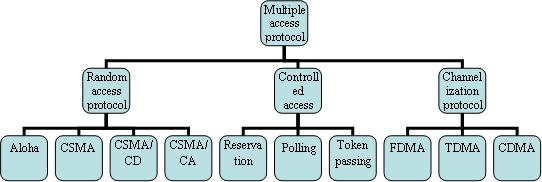
When multiple hosts are connecting to a link, we need a multiple access protocol to manage and coordinate access to the link. There exist several protocols to handle access to a shared link. Those are categorized into three groups: channelization protocol, controlled access protocol and random access protocol. 
Multiple access protocol

Random Access

Random access protocols are also known as contention protocols. In this method, at each moment, a station that has data to send uses a procedure specified by the protocol to make a decision on whether or not to send. This decision depends on whether the medium is busy or idle. In the following sections, we discuss some interesting random access protocols.

Wednesday, 6 February 2013

Multiplexing


Multiplexing is a set of techniques that allows the simultaneous transmission of multiple signals across a single link. It is much more convenient to use a single wire to carry several signals than to install a wire for every signal. Multiplexing increases the channel utilization, which means that, if the bandwidth of the channel that link two devices is grater than the bandwidth requirements, then some portion of the channel is wasted.  For multiplexing, we use two components: multiplexer and demultiplexer.  A multiplexer takes n-inputs and after combining it produces one output (many-to-one). The demultiplexer separates the combined signal into individual signals as they input to the multiplier (one-to-many).
Multiplexing
Multiplexing

Transmission Modes


Transmission of binary data across a channel can be done in either serial or parallel mode. In parallel mode, multiple bits are sent with each clock pulse but serial mode sent one bit with each clock tick. Serial transmission can accomplish in three ways: asynchronous, synchronous, and isochronous.


Transmission modes
Transmission modes

Parallel Transmission

In parallel transmission, multiple bits are sent with each clock tick. Binary data is organized into groups and send through the link. To send n-bits simultaneously we need a n-line channel. The following figure illustrate parallel transmission through a 8-line channel,

Sunday, 3 February 2013

Analog and Digital Transmission


To be transmitted data must be transformed into electromagnetic signals. Data can be analog or digital. Analog data takes continues values on some interval. For example, voice and video (are continuously varying patterns of intensity). Digital data take on discrete values, for example, data stored in a computer memory.
An analog signal is a continuously varying electromagnetic wave that may be propagated over a media. A digital signal is a sequence of voltage pulses that may be transmitted over a media.
Periodic and Non-Periodic Signals
A signal is periodic if it completes a pattern within a measurable time frame, called a period, and repeats that pattern over identical subsequent periods. The completion of one full pattern is called a cycle. A period is defined, as the amount of time (in seconds) required to complete one full cycle. Period is represented by T. A sine wave is the simple periodic signal.
A non-periodic or an aperiodic signal changes continuously without exhibiting a pattern or cycle that repeats over time.

Domain Name System

In Internet to identify a system or a host, the IP address is used. It is very difficult for people to memorize all IP addresses and people prefer to use names instead of numeric addresses. To deal with this situation we need a system that can map between name and address. When the Internet was small, mapping between IP address and host name can be done by using a single file. The file consist two columns, one for host name and other store corresponding IP address.  Today it is difficult to store all addresses in a single file for mapping. The solution is, divide this large amount of data into smaller parts and store each part on a different computer. Each host that  needs a mapping can contact the  nearest system which store the needed information. This method is used in the DNS. 
One essential requirement is that the name must be unique. A name space is used to assign unique names. In the case of flat namespace, there is no predefined structure for assigning names, but hierarchical namespace assign name space based on a structure. In the case of hierarchical namespace the name is divide into smaller

Wednesday, 30 January 2013

Email Architecture


One of the popular Internet services is electronic mail (e-mail). It is a process of exchanging digital messages from a person to one or more recipients. Here I will provide an overview of how email systems are organized and what they can do. The architecture of the email system is shown in the below figure,
Email Architecture
Email Architecture
UA: user agent
MTA: message transfer agent
MAA: message access agent

Tuesday, 29 January 2013

Tunneling Network

Tunnels are a mechanism used to send unsupported protocols across diverse networks. Tunneling is the encapsulation of packet from one protocol to another one at the same or higher layer. Virtual Private Networks (VPN) use advanced encryption and tunneling to secure, end-to-end, private network connections over a third-party network. 
As an example, consider an international organization with an IPv6 network in New York, an IPv6 network in Paris and need to connect between the offices via the IPv4 Internet. The IPv6 packets are not able to travel through an IPv4 network directly.

Sunday, 27 January 2013

IEEE Network Standards


IEEE 802.x Standards 

IEEE 802 refers to a family of IEEE standards dealing with local area networks and metropolitan area networks.

Name
Description
IEEE 802.1
Bridging (networking) and Network Management
IEEE 802.2
Logical Link Control (LLC)
IEEE 802.3
Ethernet
IEEE 802.4
Token bus
IEEE 802.5
Defines the MAC layer for a Token Ring

Satellite Network


Communication Satellite 

A communications satellite or Comsat is an artificial satellite sent to space for the purpose of telecommunications. A satellite needs to have an orbit the path in which it travels around the Earth. The orbit can be equatorial, inclined, or polar.
Equatorial orbit satellite
inclined orbit satellite
Inclined orbit satellite


Thursday, 24 January 2013

Unguided Transmission Media

Unguided media transfer electromagnetic waves without using a physical conductor. When electrons move, they produce electromagnetic waves that can transport through the free space. In vacuum, all electromagnetic waves move at the same speed. Unguided signals can travel from source to target in different ways: grounded propagation, sky propagation and line-of-sight propagation.
In ground wave propagation, radio waves travel along the surface of the earth with a frequency less than 2 MHz.  
In sky propagation, signals propagated by refraction in the ionosphere. Support frequency in between 2 MHz and 30 MHz.
In line-of-sight propagation signals are transmitted in straight lines from antenna to antenna by using frequency greater than 30 MHz.


Wireless transmission can divide into three broad classes: radio waves, microwaves, and infrared waves